


Dharma Teachings during Drikung Kagyu Monlam Retreat
shared by Venerable Khenpo Tsultrim Tenzin Rinpoche
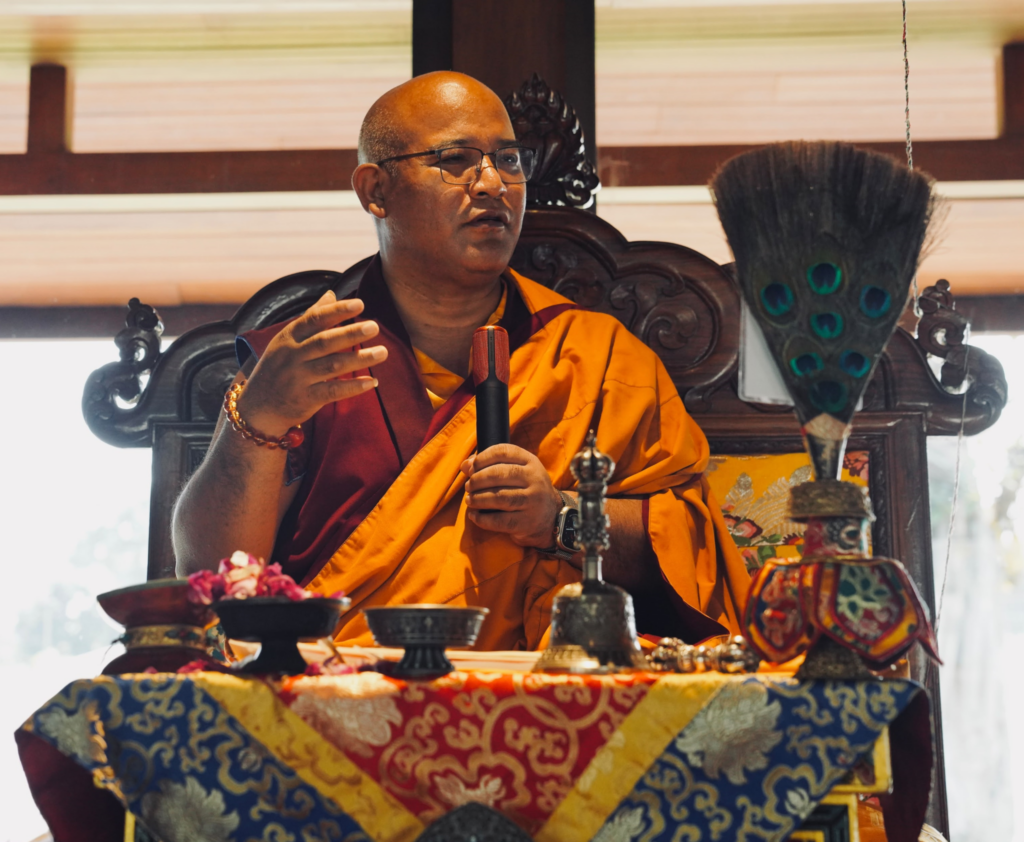
Day 1
The Essence of Mundane Dharma: Cultivating Goodness in Daily Life
In this profound teaching, Khenpo Tenzin Tsultrim Rinpoche illuminates the path to becoming a truly good human being through the practice of Mundane Dharma. At its core, Mundane Dharma is not merely a set of religious precepts but a way of life that encompasses responsibility, discipline, and compassion. It teaches us that true freedom is not the absence of rules but the mastery of oneself through ethical living and mindful action.
Rinpoche begins by emphasizing the importance of expanding our sense of self beyond the narrow confines of “me, me, me.” To be a good human being, we must include our family, friends, community, and even our environment in our sphere of care. This inclusive approach is the foundation of Mundane Dharma, which teaches that being a good citizen, a loving family member, and a responsible individual are all integral parts of spiritual practice.
Mundane Dharma: The Path of Responsibility and Discipline
Mundane Dharma, often referred to as the “basic” or “fundamental” Dharma, is about embracing our responsibilities with a disciplined and righteous heart. It calls us to be good citizens, devoted parents, caring children, supportive siblings, and committed partners. Rinpoche reminds us that these roles are not separate from our spiritual journey but are, in fact, the very ground upon which we cultivate virtue.
Discipline, Rinpoche teaches, is the key to freedom. Without discipline, even the smallest actions can draw attention and create chaos. But with discipline, we gain the freedom to act without causing harm or disturbance. He illustrates this with a vivid analogy: imagine a flock of sheep tied together with a belt. The disciplined sheep stay close to the group, moving in harmony, while the undisciplined ones stray, causing trouble. Similarly, a disciplined mind and life lead to inner peace and outer harmony.
Rinpoche shares a personal story from his childhood in the monastery, where he observed how discipline allowed him to make mistakes without anyone noticing—because his overall conduct was steady and reliable. Conversely, when discipline was lacking, even minor actions drew attention. This teaches us that discipline grants us the freedom to be imperfect within the bounds of responsibility, while indiscipline makes us slaves to scrutiny and judgment.
The Six Paramitas: Transforming Daily Life into Spiritual Practice
Rinpoche introduces the six paramitas—generosity, morality, patience, perseverance, mental concentration, and wisdom—as practical tools to integrate spiritual practice into our daily lives. These paramitas are not confined to meditation cushions or temple halls; they are meant to be lived in our jobs, our interactions, and our everyday activities.
For instance, when we approach our work with a motivation of compassion and service, our efforts become an act of generosity. When we perform our tasks with honesty and sincerity, we cultivate morality. When we face challenges with joy and resilience, we practice patience and perseverance. And when we focus our minds on the task at hand, we develop mental concentration. Ultimately, these actions lead to wisdom—the ability to discern right from wrong and act accordingly.
Rinpoche emphasizes that even mundane activities can become spiritual practice if infused with pure intention. He cautions, however, that without a good heart and compassionate motivation, even religious practices can become distorted and harmful. True spirituality, therefore, begins with the cultivation of a good intention—a heart that seeks to benefit others rather than oneself.
The Power of Intention: The Heart of Spiritual Practice
At the heart of Mundane Dharma lies the power of intention. Rinpoche repeatedly stresses that our actions, no matter how virtuous they may appear, are only as good as the intentions behind them. For example, giving chocolate to someone with diabetes may seem kind, but the intention behind it could lead to harm. Similarly, performing rituals with a selfish or impure motivation may not yield the desired spiritual benefits.
In Buddhism, the concept of motivation is central to the Mahayana path. Rinpoche explains that if our motivation is pure—rooted in compassion and the wish to alleviate suffering—then even our daily jobs, interactions, and challenges become opportunities to accumulate merit and grow spiritually. This is the essence of the six paramitas: they are not just practices for monastics or ascetics but for everyone, in every walk of life.
Rinpoche warns that without a good heart, even wisdom can be misused. History is filled with examples of intelligent people who used their knowledge for harmful purposes due to a lack of compassion. Thus, he concludes, the first and most crucial step on the path of Mundane Dharma—or any spiritual path—is to cultivate a good intention, a pure heart, and an unwavering commitment to the well-being of others.
The Three Trainings: The Path to Divinity
Rinpoche then turns to the teachings of Aryadeva, a great Indian master and disciple of Narayana, who famously declared that if one knows how to cultivate good human Dharma, the divine is not far away. This teaching underscores the idea that the path to spiritual realization begins with becoming a good human being. Aryadeva’s words remind us that the journey to enlightenment is not about escaping our humanity but perfecting it.
This path, as outlined in Buddhist teachings, consists of three fundamental trainings: morality, meditation (samadhi), and wisdom. These are not exclusive to any particular Buddhist tradition but are universal principles applicable to all sincere seekers.
Morality: The Foundation of Virtue
Morality, or the training in ethical conduct, is the first step. It is not merely about following rules or wearing religious robes but about embodying righteousness in thought, speech, and action. Rinpoche shares an anecdote about the Buddha’s disciple Chana, who chose to remain a layperson to care for his aging parents rather than become a monk. The Buddha himself acknowledged Chana as a “pure inner monk,” illustrating that true renunciation is not about external appearances but inner purity and service to others.
Similarly, Milarepa, the great Tibetan yogi, is often cited as the epitome of discipline, yet he lived as a layperson, drinking beer and wearing long hair. His renunciation was not of the world but of attachment and ego. This teaches us that morality is about integrity, responsibility, and selflessness, regardless of one’s lifestyle.
Meditation: Cultivating a Disciplined Mind
The second training is meditation, or samadhi, which cultivates a disciplined and pliable mind. Rinpoche uses the analogy of a stupa—a Buddhist monument with multiple tiers—to illustrate the stages of mental discipline. The outermost tier is unstable, like an undisciplined mind that jumps from thought to thought. The inner tiers become progressively more stable, symbolizing a mind that is increasingly focused and controlled. The pinnacle of the stupa represents the fully disciplined mind, capable of resting in stillness or moving with intention.
Meditation is not about forcing the mind into submission but training it to be flexible and cooperative. Just as a musician practices scales to master an instrument, a meditator trains the mind to remain steady and present. The goal is not to suppress thoughts but to cultivate a mind that is calm, clear, and responsive to wisdom.
Wisdom: Discerning Reality
The third training is wisdom, which arises from the integration of morality and meditation. Wisdom is of two kinds: mundane and supramundane. Mundane wisdom includes the skills and knowledge we use in daily life—such as medicine, art, or language—but it does not necessarily lead to liberation. Supramundane wisdom, on the other hand, is the direct realization of ultimate truth, which transcends suffering and ignorance.
Rinpoche explains that wisdom requires understanding both relative and absolute truths. Relative truth acknowledges the reality of our experiences—pain, joy, hunger, and so on—but absolute truth points to the deeper, unchanging nature of reality. Without understanding relative truth, absolute truth can become nihilistic, denying the reality of our experiences. Conversely, without absolute truth, we remain trapped in dualistic thinking—good vs. bad, self vs. other—which perpetuates suffering.
The Roots of Suffering and the Path to Liberation
Rinpoche identifies the root of suffering as ignorance, specifically the ignorance of dualistic thinking. When we perceive reality through the lens of duality—“me” vs. “you,” “good” vs. “bad”—we generate attachment, aversion, and other afflicted emotions. These emotions lead to negative actions (karma), which in turn create suffering.
To break this cycle, we must cultivate non-dual wisdom, which sees beyond the illusions of separation. In Theravada Buddhism, this is often described as the realization of “no-self” (anatta), while in Mahayana, it is the understanding of emptiness (shunyata). In Vajrayana, it may be described as recognizing the primordial nature (nyuma) of mind. Regardless of the terminology, the goal is the same: to dissolve the ego’s grip on reality and see the interconnectedness of all things.
Rinpoche emphasizes that morality and meditation alone cannot eliminate afflicted emotions at their root. They can control or suppress these emotions temporarily, but true liberation requires wisdom—the direct insight into the nature of reality. This wisdom cuts through the delusions that bind us to samsara (the cycle of rebirth and suffering).
Good Human Beings: The Foundation of a Peaceful World
Rinpoche then shifts to a more practical discussion: the necessity of being good human beings to create a peaceful society. In today’s interconnected world, where cultures and beliefs collide constantly, the ability to respect, accept, and appreciate one another is more crucial than ever. Discrimination and prejudice arise from dualistic thinking, which divides “us” from “them.” To counter this, we must cultivate a mindset of inclusivity and compassion.
Rinpoche acknowledges that while religion can be a powerful force for good, it can also become a source of conflict when misused. Some people may use religion to justify ego, attachment, or discrimination, creating more harm than harmony. Conversely, those who are not religious but live with integrity, kindness, and discipline can embody the essence of spiritual practice. The true measure of a person’s spirituality is not their adherence to doctrine but their goodness as human beings.
He shares a humorous yet profound story of a Tibetan man who struggled with smoking and drinking until he converted to Christianity. His transformation was so evident that his wife, initially resistant to his new faith, eventually converted as well. When she met the Dalai Lama, she jokingly asked to be reborn as a Buddhist in her next life because Christianity had helped her become a better person. This story underscores Rinpoche’s belief that any path—religious or not—that fosters goodness and compassion is worthy of respect.
Vajrayana Practices: The Path of Transformation
Finally, Rinpoche touches on the practices of Vajrayana Buddhism, which he divides into two categories: ripening (empowerment) and liberation instructions. Empowerment, or the initiation received from a guru, prepares the practitioner for deeper spiritual practice by aligning their mind with the lineage’s blessings. However, the Rinpoche cautions against rushing this process. Spiritual growth, like all meaningful endeavors, requires patience and gradual progress.
Liberation instructions include deity yoga, lineage prayers, and preliminary practices such as refuge, generating bodhicitta (the awakening mind), the four immeasurables (loving-kindness, compassion, joy, and equanimity), and the seven-limb offering. These practices are not mere rituals but essential steps to accumulate merit, purify obstacles, and prepare the mind for meditation.
Rinpoche explains that preliminary practices are like gathering ingredients before cooking a meal. Without them, the main practice—whether it’s meditation or deity yoga—lacks the necessary foundation. For example, refuge practice helps clarify one’s motivation, while the four immeasurables cultivate the compassionate mind essential for deity yoga. The seven-limb offering accumulates merit, which is crucial for successful practice.
He concludes by emphasizing that Vajrayana is not about quick fixes or magical solutions. True transformation requires gradual, step-by-step effort, just as a river carves a canyon not in a day but over centuries. The path to enlightenment is not a sprint but a lifelong journey of discipline, wisdom, and compassion.
The Heart of the Matter: Becoming Good Human Beings
In essence, Rinpoche’s teaching is a call to awaken to our shared humanity. Whether we follow a spiritual path or not, the qualities of goodness, discipline, and compassion are universal. They are the threads that weave together a peaceful society and a meaningful life.
The path begins with intention—the decision to act with kindness, to include others in our circle of care, and to take responsibility for our actions. From there, we cultivate discipline to steady our minds and actions, and wisdom to see beyond illusion. Along the way, we integrate these qualities into our daily lives, transforming even the most mundane tasks into opportunities for growth.
Ultimately, Rinpoche reminds us, the goal is not to become perfect but to become better—to cultivate a heart that is open, a mind that is clear, and a life that is dedicated to the well-being of all beings. In doing so, we not only fulfill the essence of Mundane Dharma but also honor the deepest aspirations of our shared humanity.
Note: The text will be revised and possibly edited by Venerable Khenpo Tsultrim Tenzin Rinpoche at a later time.
Day 2
Yesterday, we briefly explored the subject of compassion and its benefits. In Buddhism, compassion is part of what we call the four Brahma Vihāra meditations—a practice found in both Theravāda and Mahāyāna traditions. The term Brahma Vihāra refers to the “divine abodes,” states of mind cultivated through meditation that lead to rebirth in the Brahma realms. These four immeasurable qualities are loving-kindness (mettā), compassion (karuṇā), empathetic joy (muditā), and equanimity (upekkhā).
The name Brahma Vihāra comes from the Brahma realm, where beings are said to possess these four qualities equally toward all beings under their care. Unlike in our human experience—where we often feel more affection for some than others—beings in the Brahma realm extend their loving-kindness and compassion without discrimination. This is the ideal we aspire to cultivate through meditation.
Yesterday, we discussed compassion in the context of unconditional love. True compassion arises naturally when we have unconditional love. There are two types of love: one rooted in desire, which can lead to harm or exploitation, and another rooted in care and kindness, which seeks to protect and nurture. For example, animal activists who protect animals demonstrate love rooted in care, while those who love animals solely for consumption demonstrate love rooted in desire. Buddhism emphasizes love rooted in care—unconditional and selfless.
So, what does love truly mean in the Buddhist context?
Love means wanting others to be happy and, importantly, wanting them to have the causes of happiness. This is not an easy practice. It begins with loving ourselves. Many of us struggle to love ourselves because we focus on our shortcomings rather than our good qualities. Buddhism teaches that we should first recognize and appreciate our own Buddha nature, our human body, our freedom, and the favorable conditions we have. By acknowledging these, we can begin to love ourselves genuinely. This self-love is not arrogance but a recognition of our inherent worth and potential.
Once we cultivate self-love, we can extend it to others. Start with someone who has shown you kindness—perhaps a parent, a spouse, a child, or even a pet. Reflect on the four kinds of kindness we receive in life:
1. The kindness of giving us our body (our biological mother).
2. The kindness of protecting our life, especially in our early years when we are vulnerable.
3. The kindness of undergoing hardship to provide for us—whether through the labor of parents or caregivers.
4. The kindness of teaching us what is right and wrong, guiding us from infancy to adulthood.
These acts of kindness are profound and often go unrecognized. We repay them not just through material support but through practicing the Dharma, which ultimately liberates us and those we love from suffering. As Patrul Rinpoche said, even if we carried our parents on our back for three circumambulations of the earth, we could never fully repay their kindness. But by dedicating our Dharma practice to them, we can repay their kindness in a way that truly benefits them.
True compassion goes beyond feeling sorry for someone in a moment of suffering. It means wanting to free them not just from immediate pain but from the root causes of suffering. This is why compassion alone is not enough; it must be paired with wisdom—the understanding of how to truly help others. This combination of compassion and wisdom is the essence of bodhicitta, the awakened mind that aspires to enlightenment for the benefit of all beings.
To develop compassion, we begin by meditating on someone dear to us—whether a loved one, a friend, or even a pet. Visualize them in a state of suffering, such as trapped in a burning hell realm, and ask yourself: What would I do to free them? This practice helps us understand the depth of our own capacity for compassion. When we truly love someone, we will go to great lengths to alleviate their suffering. This is the mark of genuine compassion.
However, our compassion is often limited by our attachments and aversions. We feel more compassion for those we love and less for those we dislike. This is where equanimity comes in—the ability to extend our love and compassion equally to all beings, regardless of our personal feelings. The Buddha himself demonstrated this equanimity. For instance, he had equal love for his cousin Devadatta, who spent his life trying to harm him, and for his son Rāhula. This equanimity is not innate; it is cultivated through practice.
One way to cultivate equanimity is to reflect on the interconnectedness of all beings. Consider the story of the Arhat Nāgadatta, who saw a man eating fish, feeding it to his child, and throwing rocks at a dog— not realizing these beings were his past-life relatives. This story reminds us that our relationships with others are fluid and complex across lifetimes. We cannot assume that those we love now were always dear to us or that those we dislike were always enemies. This understanding helps us cultivate love and compassion for all beings equally.
The third immeasurable quality is empathetic joy—rejoicing in the happiness and success of others. Without true love and compassion, we often feel jealousy when others thrive. But when our hearts are open, we can genuinely celebrate the joy of others, just as a mother rejoices in her child’s success without reservation.
The fourth quality is equanimity itself—remaining balanced and undisturbed by the fluctuations of joy and sorrow. This does not mean indifference but rather a deep, unwavering peace that comes from recognizing the equality of all beings.
These four immeasurable qualities—loving-kindness, compassion, empathetic joy, and equanimity—are not just Buddhist practices. They are universal human values that anyone can cultivate, regardless of their religious beliefs. They are our true nature, obscured by negative emotions like anger, hatred, and jealousy. These negative emotions are not our natural state; they are temporary disturbances that cloud our innate goodness.
To train our minds in these qualities, we start small. Begin by meditating on someone who has shown you kindness. Cultivate loving-kindness toward them until it becomes a strong, natural feeling. Then gradually extend this feeling to others you know, and eventually to all beings. This process takes time and consistent practice, much like breaking a long-standing habit. But with dedication, these qualities can become our default state, bringing us peace, happiness, and a deeper connection to the world around us.
Tomorrow, we will engage in a two-day prayer session. When praying before a holy object, our intentions have a stronger impact. Visualize your loved ones on your right side, yourself in the center, and all other sentient beings behind you. Imagine everyone praying together with you. This visualization ensures that your practice benefits not only yourself but all beings. Remember, the Buddha’s blessings are available to everyone equally—there is no discrimination in the Dharma.
So, I encourage you to join the prayer sessions as fully as possible over the next two days. Include in your prayers not only those who are alive but also those who have already passed away—your parents, relatives, and loved ones. This is profoundly important because even after someone has passed, the merit and blessings generated through dedicated prayers can help them be freed from any lingering suffering or obstacles they may face.
In Tibetan Buddhist tradition, it is common to perform annual memorial prayers for the deceased. For example, I still perform a special puja every year on the anniversary of my mother’s passing in 2009. The entire family gathers, invites monks, and spends a full day in deep prayer at home. This practice is not just a cultural tradition—it is a powerful way to support those who have passed on, helping them to overcome any difficulties and progress on their spiritual journey.
There is a beautiful story from Tibet about the great yogi Milarepa that illustrates this. Milarepa often lived in seclusion in the mountains. One time, he went to a town to collect food for a few weeks and then returned to his cave. Soon after, a massive snowstorm struck the region, making travel impossible for months. The local people assumed Milarepa would not survive without food and began preparations for his funeral rites. They calculated how long his stored food would last and planned the 49-day funeral rituals, including the suru—a Tibetan ritual of burning offerings for the deceased.
After 49 days, when the snow finally melted enough for them to reach his cave, they expected to collect his remains. But imagine their astonishment when they arrived and found Milarepa alive—cooking food! They were shocked and asked, “Master, how have you survived this long without food?” Milarepa replied that during the storm, ḍākinīs (wisdom beings) had brought him offerings, and throughout the 49 days of rituals, he had continuously received the essence of the food offerings made on his behalf. In fact, the food he had originally taken with him hadn’t even been half consumed.
This story—and others like it—shows us that when we dedicate prayers and offerings with sincere faith, those who have passed away can actually receive the blessings directly. Their consciousness can benefit from the merit we generate, even across great distances or long periods of time.
So during the next two days of prayer, please visualize your parents—whether they are alive or have passed—as standing beside you. Include your children, your family, and all your loved ones in front of you. Behind you, visualize all sentient beings—every being in the universe—joining in the prayer with you. This shared practice amplifies the power of the blessings for everyone involved.
Some traditions suggest placing your enemies in front of you during visualization to cultivate equanimity and compassion toward them. While this is a profound practice in Mahayana Buddhism, it can be challenging. So for practical purposes, I recommend visualizing your loved ones in front and all sentient beings behind you. As you chant and pray together, feel their presence and their participation in the merit you are creating.
With this understanding, I think it is best to conclude our session for tonight. May your prayers be sincere, your hearts open, and your minds clear. May all beings benefit from the merit we generate together.
Thank you.
Sādhu, sādhu, sādhu. Thank you.
Note: The text will be revised and possibly edited by Venerable Khenpo Tsultrim Tenzin Rinpoche at a later time.
Day 3
Over the past two days, we have explored foundational aspects of the Buddhist path. On the first day, we examined the distinction between mundane dharma and supramundane dharma. Mundane dharma encompasses the ethical and responsible way to live in the world—how to be good, how to behave, and how to cultivate a meaningful and virtuous life. Each of us carries our own responsibilities, and it is crucial that we take these seriously. Supramundane dharma, on the other hand, refers to the path to enlightenment as taught by Shakyamuni Buddha. This path goes beyond worldly ethics and leads to the ultimate liberation from suffering.
Yesterday, we delved into the practice of the four immeasurable qualities — loving-kindness, compassion, joy, and equanimity. These qualities, also known as the four paramitas in Sanskrit, are essential for cultivating a boundless heart. Loving-kindness (metta) is the wish for all beings to be happy. Compassion (karuna) is the wish for all beings to be free from suffering. Joy (mudita) is the ability to rejoice in the happiness of others. Equanimity (upekkha) is the balanced state of mind that allows us to remain undisturbed by the fluctuations of joy and sorrow.
Today, we turn our attention to bodhichitta, the awakened mind that aspires to enlightenment for the benefit of all beings. This is a central theme in Mahayana Buddhism, which emphasizes the path of the bodhisattva—the one who seeks enlightenment not only for their own liberation but for the liberation of all sentient beings.
Buddhism stands apart from other spiritual traditions in its emphasis on a step-by-step path to awakening. While many traditions speak of universal love and the goal of liberation, Buddhism uniquely provides the methods to achieve this goal. The Buddha did not merely point to the destination; he showed the path, and it is up to each of us to walk it. As the Buddha himself said, “I show you the path. Whether you achieve the result depends on your effort.”
The four immeasurable qualities we discussed yesterday are the soil, moisture, and warmth that prepare the ground for bodhichitta to arise. Loving-kindness is like fertile soil, compassion is the moisture that nourishes the seed, and wisdom is the warmth that allows the seed to germinate. When these three are present, the seed of bodhichitta can grow and flourish, leading to the fruit of Buddhahood.
Bodhichitta can be divided into two aspects: relative bodhichitta and absolute bodhichitta. Relative bodhichitta is further divided into aspiration bodhichitta and action bodhichitta. Aspiration bodhichitta is the heartfelt wish to attain enlightenment for the benefit of all beings. This arises from compassion—the deep desire to free all beings from suffering. Action bodhichitta is the actual engagement in practices that lead to enlightenment, such as studying the Dharma, meditating, and cultivating wisdom and compassion.
Consider the story of Atisha, a great Indian master who traveled to Indonesia to learn about bodhichitta. The journey was perilous, filled with storms and dangers. Atisha prayed to Tara, the female Buddha of compassion, and was saved from the storm. He spent twelve years studying with his guru, Dharmakirti, and upon his return to Tibet, he held his guru in the highest regard, saying that bodhichitta was the most precious teaching he had received. This story illustrates the importance of bodhichitta in the Buddhist path and the lengths to which practitioners go to cultivate it.
Why is bodhichitta so essential?
Because it is the motivation that drives us to seek enlightenment not just for ourselves but for the benefit of all beings. Without bodhichitta, our practice can become self-centered, and our efforts may lack the depth and sincerity needed to truly transform our minds and hearts. Bodhichitta ensures that our spiritual journey is rooted in compassion and wisdom, making it a path of service and altruism.
To cultivate bodhichitta, we must first develop loving-kindness and compassion. Without these qualities, our aspiration to become enlightened for the benefit of others will lack sincerity and depth. Many of us may have received the bodhisattva vow multiple times, but if our hearts are not truly transformed by loving-kindness and compassion, our practice remains superficial. The bodhisattva vow is not a magical ritual that instantly transforms us; it is a commitment that must be nurtured by our daily practice of the Dharma.
The three trainings—morality, concentration, and wisdom—are the foundation of the Buddhist path. These trainings are emphasized in all Buddhist traditions, whether Theravada, Mahayana, or Vajrayana, though they may be expressed in different ways. In Theravada Buddhism, these are known as the Eightfold Path: right view, right intention, right speech, right action, right livelihood, right effort, right mindfulness, and right concentration. In Mahayana Buddhism, they are expressed as the Six Paramitas: generosity, morality, patience, perseverance, concentration, and wisdom.
Morality (sila) is the training in ethical conduct, which helps us overcome attachment and aversion. Concentration (samadhi) is the training in meditation, which calms and focuses the mind. Wisdom (prajna) is the training in understanding the true nature of reality, which helps us overcome ignorance. These three trainings are interconnected; morality supports concentration, concentration supports wisdom, and wisdom supports morality. Together, they form a complete path to liberation.
The teachings on morality, concentration, and wisdom can be traced back to the three baskets of Buddhist scriptures: the Vinaya Pitaka, the Sutta Pitaka, and the Abhidhamma Pitaka. The Vinaya teaches us how to renounce attachment and live ethically. The Suttas teach us how to cultivate concentration and wisdom through meditation. The Abhidhamma provides a detailed analysis of the nature of reality, helping us to overcome ignorance.
It is important to remember that the different expressions of these teachings across Buddhist traditions—whether the Eightfold Path, the Six Paramitas, or the three trainings—are all pointing to the same essential truths. The differences we see in dress, language, and cultural expressions are adaptations to local contexts and are not fundamental divisions in the teachings. The core of the Dharma remains the same: the cultivation of morality, concentration, and wisdom to overcome the three poisons of attachment, aversion, and ignorance.
In Vajrayana Buddhism, which is a part of the Mahayana tradition, bodhichitta takes on even greater importance. Vajrayana practices, such as deity yoga, rely heavily on the practitioner’s ability to generate bodhichitta. Without bodhichitta, even advanced practices can become distorted or lead to negative outcomes. For example, a practitioner who develops great wisdom but lacks compassion may become arrogant or even harmful. Bodhichitta acts as a balance, ensuring that our spiritual attainments are used for the benefit of all beings.
Imagine driving on a narrow mountain road. If you veer too far to one side, you risk crashing into the rocks. If you veer too far to the other side, you risk plunging off the cliff. The only safe path is to stay in the middle, where wisdom and compassion are balanced. This balance is what bodhichitta provides. It ensures that our spiritual practice remains grounded in altruism and wisdom, preventing us from falling into the extremes of egoism or nihilism.
So, how do we generate bodhichitta? It begins with cultivating loving-kindness and compassion for all beings. We start by directing these qualities toward those we love, then gradually expand our circle to include strangers, difficult people, and ultimately all sentient beings. As our hearts open, we begin to see the suffering of others as our own, and our aspiration to attain enlightenment for their benefit grows stronger.
It is said that when we generate bodhichitta, all the beings who are connected to us in this life—our family, friends, and even those with whom we have had conflicts—will be the first to benefit when we attain enlightenment. This is because our motivation to help them was sincere and rooted in compassion. In this way, bodhichitta is not just a lofty ideal; it is a practical and transformative force that shapes our spiritual journey and ripples out to touch the lives of others.
As we conclude today’s teaching, let us reflect on the importance of bodhichitta in our lives. Whether we are practicing the foundational teachings of morality, concentration, and wisdom, or engaging in advanced Vajrayana practices, bodhichitta is the heart of the path. It reminds us that our spiritual practice is not just about personal liberation but about the liberation of all beings. Let us cultivate this awakened mind with sincerity and dedication, knowing that every step we take on this path brings us closer to the goal of enlightenment—for our benefit and for the benefit of all.
May all beings be happy.
May all beings be free from suffering.
May all beings rejoice in the happiness of others.
May all beings abide in equanimity, free from attachment and aversion.
Sadhu, sadhu, sadhu. Thank you.
Note: The text will be revised and possibly edited by Venerable Khenpo Tsultrim Tenzin Rinpoche at a later time.
Day 4
Good evening, everyone.
When we engage in the Dharma, we often speak of virtue as the beginning, the middle, and the end of our practice. What does this mean? It means that virtue must permeate every aspect of our journey—our initial motivation, our ongoing practice, and the culmination of our efforts. At the very start, our intention is crucial. Every action we take, whether mundane or spiritual, is driven by an intention. In the context of Dharma practice, this intention must be rooted in compassion. We must ask ourselves: Why am I engaging in this practice? Is it solely for my own benefit, or do I wish to alleviate the suffering of all sentient beings?
For many years, we have focused solely on our own well-being, yet the problems we face persist. No matter how hard we try to help ourselves, the cycle of suffering continues. This is because our self-cherishing gives rise to negative emotions such as attachment, aversion, hatred, and jealousy. To break free from this cycle, we must shift our motivation. Instead of prioritizing ourselves, we must cultivate an altruistic intention driven by compassion. When our motivation is rooted in compassion, negative emotions lose their grip on us. Jealousy, attachment, and anger find no fertile ground in a mind that is dedicated to the welfare of others. This is why virtue at the beginning is so essential: it is the foundation upon which all subsequent practice is built.
Virtue in the middle of our practice means engaging with the Dharma in a way that is supported by both compassion and wisdom. Compassion, or method, and wisdom, particularly the wisdom of emptiness, are the two wings that allow us to soar in our spiritual journey. Over the past few nights, we have explored preliminary practices such as morality, the four immeasurables, bodhicitta, and taking refuge. Tonight, our focus shifts to the actual practice, which in the Vajrayana tradition includes the generation stage and the completion stage.
The generation stage is the practice of deity yoga, where we visualize ourselves as a deity. In Vajrayana, this is not merely an exercise in imagination; it is a profound transformation. We visualize ourselves as deities such as Tara, Chenrezig, or Vajrasattva, recognizing that we are not separate from these enlightened beings. To understand this, we must delve into the nature of our own existence. We are composed of the five aggregates—form, feeling, perception, mental formations, and consciousness. These aggregates, when viewed through the lens of ignorance and delusion, give rise to our ordinary, suffering-bound existence. However, when we recognize the true nature of these aggregates, they transform into the five Buddha families: the enlightened qualities of body, speech, mind, quality, and activity.
Let me explain further. Our form, when unrecognized, manifests as suffering and attachment. But when we recognize its true nature, it becomes the enlightened body of Buddha Vairochana. Similarly, our feelings, perceptions, mental formations, and consciousness each have the potential to be recognized as the wisdom of the Buddha families. This is the essence of the generation stage: recognizing that our ordinary aggregates are not inherently impure but are expressions of enlightened wisdom. The difference between our current state and enlightenment lies not in the nature of these aggregates but in our recognition of their true nature.
Why is this recognition so important?
Because as long as we grasp at our ordinary aggregates, we remain trapped in samsara, the cycle of suffering. Our aggregates become like a sponge, absorbing karma and perpetuating suffering. But when we recognize their true nature, we are liberated. This recognition is not something we achieve through force or effort alone; it is the uncovering of a latent potential that has always been present within us. Think of it like the nature of butter within milk. Milk contains the essence of butter, but it requires the right conditions—stirring, churning—to manifest. Similarly, our true nature as enlightened beings is already present within us; we simply need to create the conditions through practice to recognize it.
This brings us to the heart of the generation stage: deity yoga. In Vajrayana, we visualize ourselves as a deity not as an act of make-believe, but as a means to cut through our deeply ingrained habit of perceiving ourselves as ordinary, impure beings. When we visualize ourselves as Tara, for example, we are not merely imagining a beautiful form; we are recognizing that our true nature is inseparable from Tara’s enlightened wisdom and compassion. This practice is not about creating something new; it is about uncovering what has always been there.
The process of visualization begins with cultivating a completely empty space within our mind. Imagine yourself suspended in a vast, empty space, devoid of any conceptual framework—no body, no environment, nothing at all. This emptiness is the antidote to our habitual grasping at a solid, independent self. From this emptiness, a lotus arises, and upon the lotus, we visualize the seed syllable of the deity we are practicing. This seed syllable, often a single syllable like Om, Hum, or Tare, represents the essence of the deity’s enlightened mind. As we focus on this seed syllable, it gradually transforms into the complete form of the deity.
There are three key aspects to focus on during this visualization. First, we must strive to see the deity’s form as clearly as possible. This clarity is not about visual perfection; it is about the stability and vividness of our attention. Second, we must understand the symbolic meaning behind the deity’s form. Each color, gesture, and attribute carries profound significance. For instance, Chenrezig’s four arms symbolize the four immeasurables—love, compassion, joy, and equanimity—while the colors of the five Buddha families represent different aspects of enlightened wisdom. Finally, and most importantly, we must cultivate the confidence that we are the deity. This is not a matter of belief or imagination; it is a recognition of the non-dual nature of our mind and the deity’s wisdom mind.
This recognition—that we are not separate from the deity—is the essence of yoga. The word yoga means union, the joining of two seemingly separate entities into one. In this context, it is the union of our ordinary, deluded mind with the enlightened wisdom of the deity. This union is not something that happens in the future; it is the very nature of our mind right now. To illustrate this, consider the nature of space. Imagine a room divided by a wall. From one side, we see a clear boundary separating “this side” from “that side.” But if we remove the wall, the space is undivided. There is no longer any separation between “this” and “that.” Similarly, our ordinary perception creates a boundary between “me” and the deity, between “ordinary” and “enlightened.” But when we recognize the true nature of our mind, these boundaries dissolve. There is no longer a separate “me” practicing to become a deity; there is only the recognition that we have always been the deity.
This recognition is not something that happens instantly. It is the result of persistent practice over time. Just as a seed takes time to grow into a tree, our practice unfolds gradually. Some may experience swift realizations, while others may take longer. This difference depends on the seeds we have planted in past lives. If we have cultivated virtue and wisdom in previous lives, our progress in this life will be swifter. If not, our path may be more gradual. But regardless of the pace, the key is to never give up. Even if our visualizations are unclear or our progress seems slow, we must continue to practice with faith and perseverance. One day, the visualization will become clear and stable, and our recognition will deepen. Eventually, it will become effortless, and we will abide in the nature of the deity without any need for visualization.
Our physical body is also composed of the five elements—earth, water, fire, air, and space—which correspond to the five Buddha families. Earth, represented by flesh and bone, is the body of Buddha Vairochana. Water, represented by the fluids in our body, is the wisdom of Buddha Mamaki. Fire, represented by the heat in our body, is the wisdom of Buddha Ratnasambhava. Air, represented by the breath and the movement of energy within us, is the wisdom of Buddha Tara. And space, the openness within and around us, is the wisdom of Buddha Lochana. When we recognize these elements as the wisdom of the Buddha families, our ordinary perception of our body transforms. We are no longer bound by the limitations of our physical form; we recognize that our body is an expression of enlightened wisdom.
However, even as we practice deity yoga, we must be cautious not to become attached to the deity form itself. It is possible to detach from our ordinary self only to become attached to the deity. This is why the practice includes dissolution. At the end of our visualization, we dissolve the deity back into emptiness, recognizing that the deity, like all phenomena, is empty of inherent existence. This dissolution helps us cut through any remaining attachment to form, whether ordinary or divine.
The power of mindfulness is essential in this process. There is a story from India that illustrates this power of mindfulness perfectly. A great yogi was invited to the palace of a king who arranged an extravagant welcome ceremony: music, dancing, flowers, and crowds of people lining the path. After the yogi passed through this lavish display, the king asked, “How was the welcome ceremony?” The yogi replied, “What welcome ceremony? I haven’t seen anything.” The king insisted it was impossible to miss such a grand display, so the yogi agreed to a test. Unbeknownst to him, the king had instructed a servant to carry a jar of oil on his head with strict orders that if even a single drop spilled, the servant would lose his life. As the servant walked carefully, dancers and musicians performed all around him, yet he remained completely focused, carrying the oil without spilling a drop. When the test was over and the oil was removed, the king asked the yogi again about the dancing and singing. The yogi simply replied, “I didn’t see anything.”
This is the power of mindfulness—when your awareness is steady and present, no external distraction can disturb it. Until we develop this kind of control over our mind, we must persistently cultivate meditation and actively cut through our attachments, whether to ordinary appearances or to the divine forms we generate in practice.
Once we have loosened these attachments, we turn our focus inward to the nature of mind itself. This nature is described as unfabricated—not created by our thoughts or efforts, yet luminous and clear. It is like space: space has no color, no shape, no form, and yet space is not nothingness. Space is precisely what allows movement, what allows elements to function. Without space, nothing could exist or move. Similarly, in Buddhism we say that because of emptiness—because of this open, empty nature—phenomena can function and manifest. Phenomena arise within emptiness; they are not separate from it. They are like waves on the ocean: the wave appears, but the water—the emptiness—remains unchanged.
We can examine this directly through our own experience. Take any feeling—pain, joy, sadness—and investigate it with mindfulness. When sadness arises, make it stronger in your mind. Then ask: Is this sadness part of my mind, or is it separate from my mind? Is it inside or outside? Through this investigation, we discover that the feeling, no matter how strong, cannot be found as a separate entity. It arises within the mind, but when you search for it, you cannot locate it anywhere. This is the practice of mindfulness of feeling—a way to examine the nature of experience directly.
Now, returning to our practice: when we engage in generation stage or completion stage meditation, these two—mindfulness and investigation—are the essential skills that allow us to actually practice. This is what we call virtue as the middle. In Vajrayana, every practice must be supported by two pillars: emptiness and compassion. Whether you are doing deity yoga, mantra recitation, or visualization, these two—wisdom (emptiness) and method (compassion)—must be present. Without them, the practice remains hollow, like a body without a skeleton or a tree without roots.
And then comes virtue as the end—the dedication. This is often overlooked, yet it is absolutely crucial. Many of us perform virtuous actions—walking around a stupa, reciting a mantra, offering a handful of food—but we forget to dedicate the merit afterward. This is dangerous because even a moment of anger can destroy merit accumulated over a hundred years. If you do not dedicate your virtue, it remains vulnerable to being consumed by negative emotions. But when you dedicate it properly—especially to unsurpassable enlightenment—it becomes indestructible. The dedication should be clear and unwavering: “May this merit ripen in me so that I may attain buddhahood and thereby liberate all sentient beings.”
Do not dedicate merit to worldly gains like wealth or fame, for these are impermanent. Even if you become rich or famous in this life, you cannot take those things with you when you die. And in your next life, there is no guarantee that such conditions will follow you. True dedication is to enlightenment itself—for the benefit of all beings across all time.
Even the smallest acts of virtue must be dedicated. How often do we perform small, everyday acts of kindness or generosity and forget to dedicate the merit? We might do a grand puja or a long meditation session and remember to dedicate, but what about the small things? A kind word, a helpful gesture, a moment of patience—these too are sources of merit that must be dedicated.
Before any action, we set our intention—this is the aspiration prayer, the virtue as the beginning. After the action, we dedicate the result—this is the dedication, the virtue as the end. Together, they form the complete arc of spiritual practice.
Sometimes Vajrayana appears complicated—too many rituals, too many visualizations, too many prayers. But once you understand the underlying structure, everything becomes simple. All these practices fit within the framework of virtue as beginning, middle, and end. Once you break through the surface complexity, you see the simplicity beneath.
So tonight, as you reflect on these teachings, ask yourself: What is my intention when I begin my practice? Am I supported by compassion and wisdom during the practice? And after the practice, do I dedicate the merit properly? If you can align your practice with these three aspects—virtue as beginning, middle, and end—you are walking the true path of Vajrayana. And remember: if you have any questions, ask them now. No question means one of two things—either you understand everything perfectly, or you have no idea what’s going on. I prefer to assume the first.
Note: The text will be revised and possibly edited by Venerable Khenpo Tsultrim Tenzin Rinpoche at a later time.
For an overview and description of the Monlam Pilgrimage Sites, please continue here.
To read about the Sulawesi Cultural Exchange, please follow this link.
To go back to the Drikung Kagyu Monlam Retreat main page, please click here.
To read more about our other events and the pertinent teachings, click here.
Donations
You can be of direct assistance to the event by making a donation to Akhamani. Your contribution will help the unfolding of the Unifying Ancestral New Fire and benefit the elders and wisdom keepers who will share their teachings to all participants.
All donations are considered charitable tax deductions in all of the European countries, the USA, and other parts of the World.
Please enter the amount of your donation below. We thank you for your contribution and support!

To learn more about what we do visit our Events and Projects pages.