


Smoke Offering: Sang
Guided and led by venerable Khenpo Tsultrim Tenzin Rinpoche
First, I would like to thank Janet’s family for welcoming us into their home with such warmth and generosity, and for preparing such a delicious meal. Thank you as well to everyone who helped arrange this beautiful ceremony and prepare the offerings.
In Tibetan, this ceremony is called sang, which means purification. In some ways, it is similar to smoke-offering ceremonies in other traditions: offerings are placed in a fire, and the smoke rises. One difference is that in the Tibetan ritual, we generally do not use tobacco. In Tibet, plants or woods considered poisonous are not used in this kind of offering. Practices can vary, however; for example, at a great stupa in Myanmar, tobacco is traditionally offered to a protector.
Le sang has three aspects: ash, fire, and smoke. The ash represents the world beneath the earth, the fire represents the earth we live on, and the smoke represents the space above us. Through the ceremony, we offer purification across these three realms. In Tibet, purification was once performed directly through fire; over time, smoke offerings also became part of the practice.
The ceremony also includes food offerings. Traditionally, these may include what are known as the “three whites”—butter, milk, and yogurt—and the “three sweets”, such as sugar, brown sugar, and honey, along with foods that people commonly eat. The offerings are burned so that spirits, who do not have physical bodies, can receive them through their fragrance. In this way, the ritual makes offerings to local spirits, protectors, and other subtle beings.
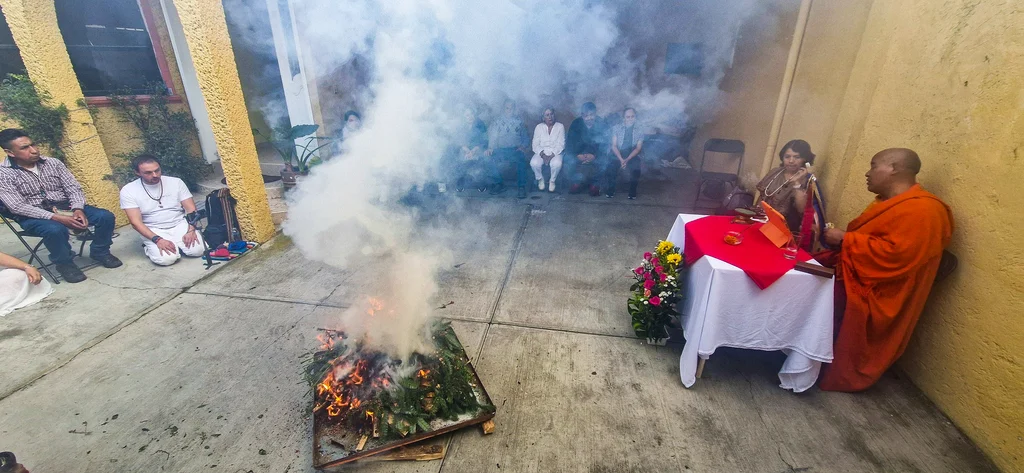
There are many similarities between Tibetan rituals and the ceremonies of native peoples. Before Buddhism came to Tibet, local traditions and rituals were already practiced there. As Buddhism took root, many of these traditions were adopted and incorporated into Tibetan Buddhist practice, rather than rejected. This is one reason Tibetan Buddhism has its own distinctive character, and why its rituals may share similarities with those of other cultures.
Through this ceremony, we purify negativity and help free ourselves from obstacles. We will now begin with the opening prayer.
The next part of the ceremony is called the Summoning of Good Fortune. The five colors represent the five elements and, in Buddhism, the Five Buddhas. Through this invocation, we call upon the essence and blessings of the five elements and the wisdom of the Five Buddhas.
The prayer that follows asks the Three Jewels and the Three Roots—and, in particular, Chenrezig, Arya Tara, and Guru Padmasambhava—to remember their sacred vows and grant their blessings. It speaks of a time when the thoughts and actions of beings have become confused and the balance of the outer and inner elements has been disturbed, bringing suffering to people, animals, and the natural world. It describes illness, harm from spirits, damaged crops, conflict, extreme weather, earthquakes, and other difficulties.
The prayer asks that these troubles quickly be dispelled from their source. May bodhicitta—the precious wish to attain awakening for the benefit of all beings—arise naturally in every mind. May harmful thoughts and actions cease, may beings feel love for one another, and may the whole world enjoy happiness and abundance. By the power of the Three Jewels, the Buddhas and bodhisattvas, the virtue gathered in samsara and nirvana, and our pure intentions, may these aspirations be fulfilled.
The recitation then calls upon Arya Tara and Chenrezig, praising Chenrezig’s thousand arms and thousand eyes, and the immeasurable reach of their compassion. It concludes with the aspiration: “May I swiftly accomplish Chenrezig through this virtue, and bring, without exception, all sentient beings to that state.”
The ceremony took place on a day considered especially sacred in Tibetan Buddhism: the day commemorating the Buddha’s return to earth after visiting the realm of the gods to teach and liberate his mother. The occasion also marked Khenpo’s fortieth anniversary of taking monastic vows, as well as the completion of the group’s pilgrimage along the Olmec route. The offerings and prayers were made in connection with the journey, in gratitude to the guardians and subtle beings encountered along the way, and as a purification of the path.
After the prayers, everyone was invited to share the celebration. The fire was to be tended until the offerings had been fully consumed, and those present were invited to help.
Discussion of Smoke Offering Between Khenpo Tsultrim Tenzin Rinpoche & Javier Peña
Fire is an important element of creation, alongside the other elements. It is also especially present in Mexico during this time of year, when candles and fires are lit in homes, churches, cemeteries, and sacred places in remembrance of the dead. In some communities, people carry candles from house to house to honor those who have passed away.
In the Otomí Yühü tradition, there are three sacred fires: the fire of the kitchen, tended by women; the ceremonial fire lit in sacred places; and the fire kept in temples. Community ceremonies may also bring together the candle flame, the smoke of copal or other offerings, and the inner fire within each person. These represent complementary forces and the divinity within. At this time of year, a great sacred fire is lit for the community and for the ancestors.
Smoke is meaningful in this tradition. People observe its direction and color, which may be understood as carrying significance. Smoke from sacred plants is also used for purification.
Khenpo Tsultrim Tenzin Reinpoche explained to Elder Javier Peña that smoke offerings are an important part of Tibetan life, too. In many Tibetan households, the day begins by lighting the kitchen fire. Then, some of the ash or embers are carried to the roof, where an offering is made to the guardian spirits. In Lhasa, people also visit temple chimneys to make morning smoke offerings. Sometimes a gold ring or another valuable item is accidentally swept into the fire. Once it has become part of the offering, it is not retrieved; the ritual matters more than the lost object. People may carry small bags containing tsampa—roasted barley flour—and materials for making smoke offerings.
Tío Javi then lit a candle to honor everyone gathered, the family who welcomed them, and the meeting of the two traditions. He offered the flame as a wish that its warmth and light remain in the family, the home, and the generations to come. He also spoke of honoring the ceremonies and work of both traditions.
Khenpo thanked everyone for joining the ceremony. Although traditions may differ, he said, it is important to learn to respect one another and coexist. Coming together in ceremony can benefit humanity and society, and is especially important for the planet and future generations. He also thanked the people who helped with the fire ceremony, particularly the women who performed the purification ritual (Elder Juana Peña and fire holder Adriana) that he greatly appreciated. He said that women are often especially kind and sensitive and praised the care they brought to their work.
He closed by thanking the family for opening their home and welcoming everyone.
For an overview and description of the Mexico–Tibet Bridge Pilgrimage Sites and Teachings, Veuillez continuer ici.
To return back to the Mexico–Tibet Bridge Pilgrimage main page, Cliquez ici.
Pour continuer la lecture sur le Pèlerinage des cendres du mandala de feu universel and pertinent teachings, please Cliquez ici.
Dons
Vous pouvez apporter une aide directe à cet événement en faisant un don à Akhamani. Votre contribution permettra le déploiement du Feu Nouveau Ancestral Unificateur et profitera aux aînés et aux gardiens de la sagesse qui partageront leurs enseignements avec tous les participants.
Tous les dons sont pris en considération des déductions fiscales pour les œuvres de bienfaisance dans tous les pays européens, aux États-Unis et dans d'autres parties du monde.
Veuillez saisir le montant de votre don ci-dessous. Nous vous remercions pour votre contribution et votre soutien !

Pour savoir plus sur ce que nous faisons avec votre aide, visitez Événements et la Projets pages.