

Pilgrimage across Anatolia
Our pilgrimage through Anatolia was a journey not just across a landscape, but through time itself—a path that traces the footsteps of ancestors who walked these lands millennia before modern borders were drawn. While today this region is often associated with the nation-state of Turkey, we choose to honor its deeper identity: Anatolia, the ancestral heartland of civilizations, empires, and spiritual traditions that have shaped human history.
This is the land where the Hittites, Phrygians, Lydians, and Byzantines left their mark. Anatolia is not merely a geographical term—it is a living testament to the endurance of culture, faith, and memory. By naming our pilgrimage through Anatolia rather than Turkey, we seek to connect with the land as it has been revered for centuries: as a sacred crossroads, a cradle of wisdom, and a place where the past and present intertwine.
Here, the modern nation-state fades into the background, and what remains is the timeless essence of the land.
Cultivating an Ancestral Bridge in the Cradle of Humanity
In August 2026 we embarked on a profound journey into the heart of Anatolia’s ancient plains. Various sites, where humanity’s earliest organized societies and ceremonial traditions emerged, served as a way to reconnect with the wisdom of our ancestors and the universal threads that bind all of humanity.
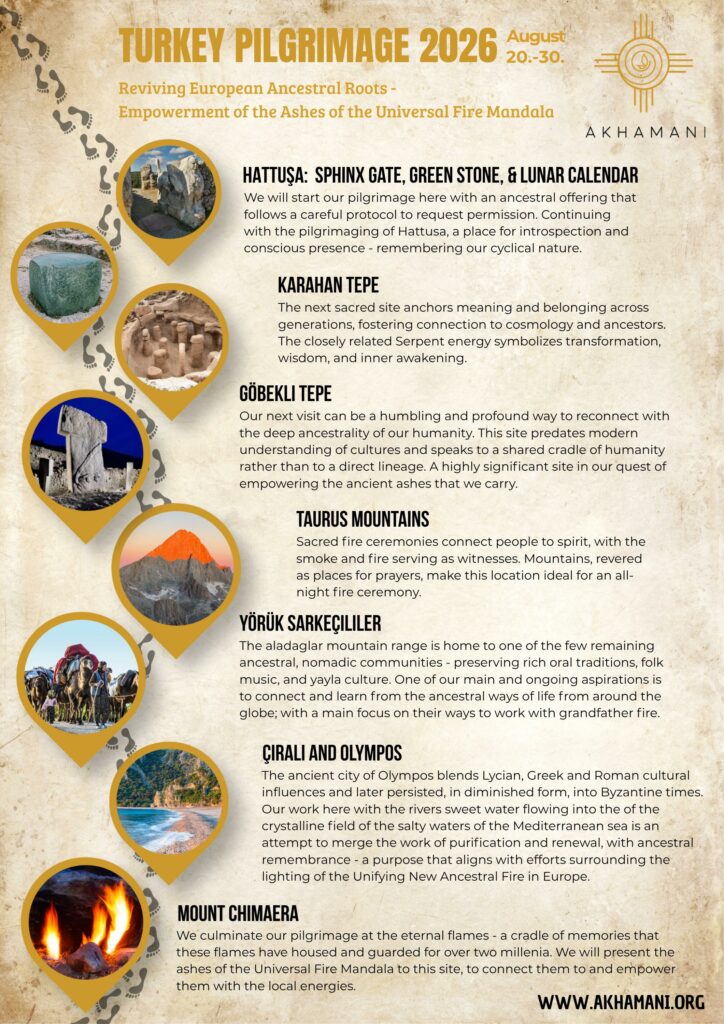
Led by Akhamani, our expedition began in Alacahöyük, home to the oldest known Hittite settlement, and Yazılıkaya, a sacred open-air sanctuary carved into the rock. From there, we ventured to Hattusa, the capital of the Hittite Empire, where we explored the remnants of one of history’s earliest organized societies. Among the excavated sites, we marveled at the Sphinx Gate, the Lions Gate, the Green Stone, and the hieroglyph chamber, each a testament to the sophistication of the Hittite civilization.
Our journey then took us to two extraordinary archaeological discoveries of our time: Karahan Tepe and Göbekli Tepe, recognized as the oldest excavated ceremonial sites in the world. Dating back to 9000 B.C., these monumental centers predate the notion of settled civilization, revealing that organized human communities with complex rituals and social structures existed far earlier than previously believed. The precisely arranged megalithic structures at those sites left us in awe, offering silent yet powerful evidence of humanity’s innate drive to connect with the sacred and the communal.
Our exploration extended to local museums, where the mosaic of Anatolia’s shared history came alive through artifacts that spanned millennia. But the heart of our journey lay in the wild, untamed landscapes of Anatolia. We embarked on a three-day hiking expedition through the rugged terrain of the Kapuzbaşı waterfalls, leading us to the serene and pure Yedigöller plateau. It was here, in the remote mountains, that we had our first encounter with the Yörük tribe, one of the last remaining nomadic communities who have preserved a way of life unchanged for over 5,000 years.
We were welcomed into their nomadic homes, where we shared meals, listened to their teachings, and were granted permission to light a sacred fire on their ancestral lands. The Yörük people are the living guardians of an unbroken fire-keeping tradition, a practice that has been passed down through generations. During our time with them, we participated in the exchange and empowerment of the ashes of the Universal Fire Mandala—a living symbol of shared humanity. The matriarch of the Yörük tribe agreed to contribute their sacred ashes, drawn from a flame that has burned continuously for several thousand years, to this ever-growing Universal Fire Mandala. These ashes, now united with those carried from ceremonies across the world—including Mongolia, Tibet, Nepal, India, Mexico, Peru, the Diné nation, the Sami people of Scandinavia, and the European fire-keeping traditions—were further empowered by ancient wisdom exchanges and the unification of ashes.
Our path then led us to Çıralı, where we explored the ruins of Olympos, an ancient city that witnessed the seamless transition of cultures over many centuries. Standing among its remnants, we reflected on the peaceful evolution of humanity, where one civilization naturally gave way to the next, each leaving its mark on the landscape and the collective memory of the land. A vital example of the mosaic of humanity.
We ended our pilgrimage on Mount Chimaera, where eternal flames have burned for thousands of years. Under the luminous glow of the full moon, we gathered to witness these sacred fires, their flickering hues of orange and, in places, a vivid blue, casting an ethereal light upon us. It was here, in the presence of these eternal flames, that Jonas and Leobardo took their vows to become carriers of the Universal Fire Mandala Ashes, committing themselves to the preservation and expansion of these ancient traditions.
This pilgrimage was more than a physical journey—it was a spiritual and cultural awakening. By walking in the footsteps of our ancestors, lighting fires alongside the Yörük people, we deepened our understanding of the guardianship of ancestral ways and the consciousness of fire. We deepened our participation in a continuum, a living bridge between past and future, carrying forward the wisdom of those who came before us.
As we concluded our journey and prepared to return home, we carried with us not only the memories of sacred sites and profound encounters but also the responsibility to honor and share the lessons of this pilgrimage. May all our actions be for the highest benefit of all creation, as we strive to keep the flame of shared humanity alive for generations to come.
“We do not inherit the earth from our ancestors — we borrow it from our children and we must return it with the memory of those who came before.”
If you would like to explore the different Pilgrimage sites from our journey through Anatolia, please click here.
To learn about the teachings from discussions on-site along the way in Anatolia, please follow this link.
To continue reading about the Pilgrimage of the Universal Fire Mandala Ashes as well as the pertinent teachings, please click here.
Donations
You can be of direct assistance to the event by making a donation to Akhamani. Your contribution will help the unfolding of the Unifying Ancestral New Fire and benefit the elders and wisdom keepers who will share their teachings to all participants.
All donations are considered charitable tax deductions in all of the European countries, the USA, and other parts of the World.
Please enter the amount of your donation below. We thank you for your contribution and support!

To learn more about what we do visit our Events and Projects pages.